

If you own a brand that manufactures products for a long time, there’s probably a big concern in your mind:
How do I make my products relevant in today’s world?
Being in the B2B market, this is one of my constant concerns as well.
Through the years, marketing and pitching ideas changed dramatically. Social media is one good reason for that change. Through it, one’s ideas and stories become more important to the consumers than the actual products.
Bill Gates and His Idea of Content Marketing
Bill Gates, in his essay entitled “Content is King” from 1996, talked about how content creation will be the biggest business opportunity for companies to strive.

“Content is where I expect much of the real money will be made on the Internet (…) the broad opportunities for most companies involve supplying information or entertainment. No company is too small to participate.”
See the full essay here.
We were in 1996 and it was a time where the internet and the role of business inside the internet were all very speculative. Despite that, this was the article that Bill Gates decided to post on the homepage of Microsoft at the time.
See Also: 9 Powerful Lessons from the Success Story of Bill Gates
Importance of Storytelling In Marketing
The market today has been swallowed by social media. If you want to grow your business and make your products relevant, you have to be where the market is. You have to be where your customer is and you have to create content that matters.
But, these are the hard questions:
What content should you make? What do your costumers want? And what is “relevant” nowadays?
Doug Kessler, Creative Director and Founder of Velocity, addresses these problems very well:
“Traditional marketing talks at people. Content marketing talks with them.” – quote from his Twitter.
In other words, don’t make your content about yourself or even about your company. You should make it about your customers.
Stop caring about what you want your brand to represent. You need to actually hear your market and make your marketing reflect what your customers care about.
If you can do that, it won’t matter how “old” your products/brands are or how aware your customers are of your existence. You will instantly be relevant and have everyone talking about your products.
In fact, even though content marketing is done by everyone these days, the concept is not “new” at all.
Take JELL-O for example. Yes, JELL-O, a gelatin company that started in 1897 in New York. It started as a FREE cooking magazine in 1904, displaying and using their products. By 1906, the company went over 1 million dollars in sales.
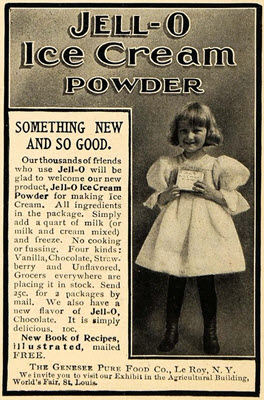
1904 adverting of a “JELL-O Ice-Cream”
Read the full JELL-O story here.
Another example of this was when Hasbro and Marvel decided to create the GI Joe comic books. The comics quickly escalated to a revolution in the toy industry, selling not only GI Joe toys but also movies and an entire cartoon show. It became a success as those two companies told a story that connected to their audience.
Even the term “soap opera”, a term that exists to this day, was created under the umbrella of content marketing. It happened when a brand of laundry soap (Oxydol) sponsored a local pioneer radio show. It performed a story to their audience instead of the usual shows and music. As a result, the first “soap” opera, Ma Perkins, was born.
Rip Curl, a surf-wear company, has an entire online magazine dedicated to the surfer lifestyle, searching for the best waves, the best photography, and the best stories told by surfers. It’s called “The Search” and it has 100,000 YouTube subscribers and 2 million Facebook followers.
GE is another great example. It’s a B2B company that sells vacuum cleaners, dishwashers, and products that you would say aren’t very interesting to display on social media and don’t particularly tell any story.
So, GE contacted local Instagram influencers and gave them permission to photograph their facilities in any way they found interesting. The results were an increase of 8 million views on Instagram, more 3 thousand followers, and an outstanding increase of tours of the facility.
And they keep innovating. Here’s another story about GE.
Even in my daily life as a marketer in a B2B company, I see content marketing doing its “magic” even without realizing it’s happening.
It happened with Giotto, a worldwide pencil and paint manufacturing brand that has been around since 1920. It’s a brand that has been around for some time and I wouldn’t say it’s been “relevant to the customer” in a number of years.
Well, some time ago, they called my company saying that they have a new product and that they displayed it on Instagram and YouTube. That time, people went crazy over it and they don’t know exactly why.
The product itself? A box with 12 colored pencils.
The colors of the pencils? Different skin tones of people that exist around the world. The product is called Giotto Stilnovo Skintones.
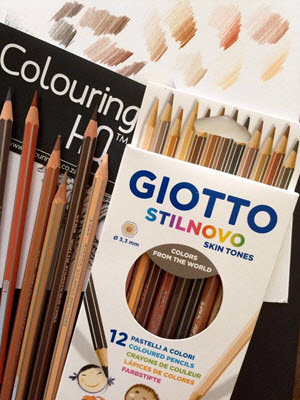
Obviously, the product solved a common problem among painters who only had two or three pencils to paint people. It’s also obvious that the people at Giotto were “victims” of one thing: content marketing.
They essentially created a product that is not only useful to the consumer but also relates to a very current topic: race. We live in a world where race is being discussed more than ever. Social injustices that are born on racism are being tackled and questioned by everyone.
Every parent that has to buy colored pencils for their kids at school thought the same when they saw Giotto’s new product. They want one for their kids and that is what content marketing is all about. It´s about connecting the concerns of your consumers to your products in a meaningful way.
Conclusion
So how do you make your product or service more relevant?
Stop selling and start storytelling. That is the key to relevancy and content marketing.