


Let’s be honest — the Charlie Kirk funeral was not your average goodbye. It was loud, intense, political, emotional, and unforgettable. You could feel it in the air — this wasn’t just about saying farewell. It was a national moment, a cultural flashpoint. From the very first announcement of Charlie Kirk’s assassination, things spiraled into high drama. But it wasn’t just the death that got people talking. It was the funeral that pulled the whole country into one massive, chaotic moment of reckoning.
Charlie Kirk wasn’t just a person. He was a movement, a microphone, a headline on Fox, and a target in the New York Times. Whether you were a fan or not, you couldn’t look away. People weren’t just mourning a man — they were mourning a symbol of conservative youth culture. And baby, when a symbol falls, the world watches. The moment he was gone, the energy around his name exploded. Suddenly, “Charlie Kirk” wasn’t just trending — it was echoing through churches, newsrooms, dorm rooms, and political rallies.
For many, the memorial service for Charlie became more than just a goodbye. It turned into a reflection of a divided nation — where one side saw a hero taken too soon, and the other saw political theater. The atmosphere inside the stadium was electric, with emotions running high, some teetering between grief and fury. It was a day that blended mourning with messaging — something all too familiar in today’s political landscape.
If you’re wondering why everyone and their grandma was talking about the Charlie Kirk funeral, buckle up. We’re going to walk through every juicy, tear-jerking, tweet-worthy moment — from the State Farm Stadium in Glendale Arizona to President Donald Trump’s emotional speech, and everything in between. Grab your tissues and maybe a glass of wine because this was one for the books.
When and Where It All Happened

So let’s break it down for those who missed the headlines: State Farm Stadium, where the service took place, filled up within hours of doors opening. That’s right — they didn’t book a cute little church or even a fancy indoor arena. They went big. Like, Super Bowl-level big. You don’t gather tens of thousands of people in a community center. You need a stadium. That alone speaks volumes about the public reaction to Kirk’s death and the movement he represented.
Held just days after Kirk’s assassination, the memorial service took place on a clear, emotionally charged afternoon. Many attendees dressed in red, white, and blue attire as requested by Turning Point USA for the memorial. The mood was heavy, and security was tight — expected, given the nature of Kirk’s death and his controversial reputation. The event drew attendees from across the country, with some arriving as early as 4 a.m. to secure their place.
Additional seating was made available at the adjacent Desert Diamond Arena due to high attendance. The setup was grand. Giant American flags draped the ends of the stadium. Jumbotrons flashed photo montages of Kirk’s life, and enormous banners read: “Honor Charlie Kirk.” Subtle? Absolutely not. But it reflected the scale of his following and the seriousness with which his supporters took this moment.
The location itself sent a message. Glendale Arizona — a battleground city in a battleground state — became a symbolic host. The setting echoed everything Kirk represented: bold moves, bigger platforms, and a constant fight for attention. For better or worse, the venue spoke volumes about how his supporters wanted him remembered — as someone too big to ignore, even in death.
Who Showed Up to Honor Charlie Kirk?
Now let’s spill the tea on who actually showed up — because this wasn’t your average guest list. It was stacked. Some 200,000 people turned out to honor Charlie Kirk at his funeral service. The front row was like a live feed of conservative influencers, politicians, and high-profile supporters. There were suits, dark sunglasses, microphones, and cameras everywhere. This was no private event — it was the event.
Leading the lineup were President Donald Trump and Vice President JD Vance. The presence of both current and former White House figures sent a clear signal about Kirk’s political pull. Love or loathe the man, he made powerful friends. Alongside them stood Donald Trump Jr, Stephen Miller, and Anna Paulina Luna, all of whom have become household names in conservative circles. Even Tulsi Gabbard, former National Intelligence figure, made an appearance, keeping things unpredictable and slightly tense.
Also spotted were representatives from Turning Point USA and its sister organization Point USA, which Kirk co-founded. These weren’t just coworkers; they were his disciples, so to speak. Students and young professionals from across the country made the pilgrimage to Glendale Ariz to honor a man they considered their voice. Some held signs. Some simply held hands. But their loyalty? Loud and clear. Their grief wasn’t staged — it was raw, and it was real.
Other notable guests included Human Services Secretary Robert and even White House Deputy Chief aides, suggesting this was not just a partisan event but a high-level political occasion. Whether people came out of respect or obligation, their presence alone added weight. And let’s not forget the regular folks — the ones who never missed a podcast, a livestream, or a Turning Point rally. This crowd wasn’t just mourning; they were mobilizing. And that made the whole thing feel even bigger than anyone expected.
READ ALSO: Charlie Kirk Dead? Here’s What Actually Went Down
President Donald Trump Speaks: A Eulogy That Went Viral
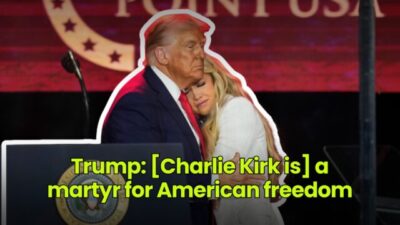
When President Donald Trump took the stage at the Charlie Kirk funeral, the reaction was immediate. People stood, clapped, and some even cheered — though others remained more somber, treating it as a moment of reflection. Trump, never one to shrink into the background, took center stage like it was his natural habitat. His voice was steady, his words emotional, and his presence unavoidable. Love him or hate him, you can’t deny that the room changed the second he opened his mouth.
In his speech, Trump didn’t just speak about loss. He spoke about legacy. Trump referred to Charlie Kirk as a “martyr for American freedom,” “a fierce voice for American liberty,” and “a young man with more courage than most men twice his age.” He mentioned how Kirk’s message had mobilized a generation and insisted his influence wouldn’t be buried with him. President Trump characterized Charlie Kirk’s assassination as an assault on all conservative ideals. Trump said the gun was pointed at Kirk, but the bullet was aimed at all conservatives. That line stirred a mix of applause and raised eyebrows.
Critics watching from home — and even a few in the audience — felt that Trump’s eulogy leaned too much into political rhetoric. Instead of focusing solely on Kirk’s life, parts of the speech seemed aimed at energizing a voter base. That’s the thing with Trump — he brings passion, but often blurs the line between tribute and rally. And for a memorial, that’s a tricky balance to manage. Other speakers at Kirk’s memorial, including Vice President JD Vance, also highlighted his faith as a crucial aspect of his character and political influence.
Still, for many in attendance, the speech offered closure. Hearing the former president honor someone they deeply admired gave legitimacy to their grief. Trump’s presence affirmed that Kirk’s death was not just a personal tragedy — it was, in their eyes, a loss to the nation. Whether that’s viewed as honorable or performative depends on who you ask. But one thing’s for sure: when President Donald Trump speaks, people remember it.
Erika Kirk Speaks and Steals the Whole Show
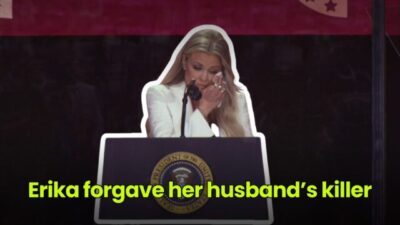
While Trump drew attention, it was Erika Kirk who drew hearts. When she stepped up to the microphone, dressed in black with a simple cross around her neck, you could feel the entire stadium hold its breath. There were no theatrics. No political zingers. Just a grieving woman with a shaky voice and a heart full of memories. In a room full of powerful people, Charlie Kirk’s widow gave the most powerful speech of the day.
She began by thanking those who came to honor her husband, then quickly turned to the man himself. “Charlie wasn’t perfect,” she admitted, “but he was passionate. And he believed that speaking the truth — even if it made enemies — was worth it.” Her honesty cut through the tension in the room. She didn’t paint Charlie as a saint. She painted him as a husband, a friend, and a relentless believer in something bigger than himself.
As Erika Kirk speaks, you realize this wasn’t just her goodbye — it was her promise. “He fought with faith. So now I will, too,” she said, as tears welled up in her eyes. Erika Kirk, Charlie Kirk’s widow, forgave her husband’s accused killer at the service. The room responded with a standing ovation, the kind of applause you don’t often hear at funerals. And in that moment, it wasn’t about politics. It was about love. About legacy. About loss.
Some viewers later commented that Erika’s eulogy offered the one thing missing from many of the other speeches — balance. The crowd showed overwhelming emotion, with standing ovations in response to Erika Kirk’s forgiveness speech. Her vulnerability was a reminder that at the core of every movement is a person. And when that person is gone, the heartbreak is all too real.
Charlie Kirk’s Assassination: The Tragic Catalyst
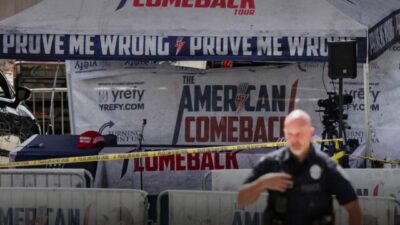
Of course, none of this would’ve happened — the funeral, the tributes, the headlines — if not for the shocking and violent event that came first: Charlie Kirk’s assassination. It was a chilling moment, one that flipped the conservative world on its head. And whether you followed Kirk’s organization, criticized his politics, or had never heard of him until the news broke, the brutality of his death got everyone’s attention.
Authorities were quick to label it political violence, pointing to the way Kirk had long been a controversial public figure. Early reports indicated that the attack was planned. The suspect, now in custody, allegedly followed Kirk’s movements for weeks and waited for the right opportunity. It happened outside a private event, in what many now describe as a moment of silence before the storm. Kirk’s death wasn’t just tragic — it was intentional. And that changed everything.
Some of Kirk’s critics accused conservative media of overhyping the story. Others argued the opposite — that outlets like the New York Times downplayed the significance of the act. Conspiracy theories took off. Was it politically motivated? Was it a lone wolf? In the age of disinformation, facts can be hard to pin down — but the grief? That was undeniable. A young, prominent political activist was gunned down. No amount of spin could erase that.
And here’s the haunting truth: whether you liked Charlie Kirk or not, his assassination set a new and disturbing precedent. If political violence becomes the new language of disagreement, we’re in deep trouble. The funeral wasn’t just about remembering Kirk’s life — it was about grappling with the consequences of his death. A warning. A wake-up call. A deeply uncomfortable reminder of how fragile civil discourse has become.
Songs, Tears, and a Spiritual Revival
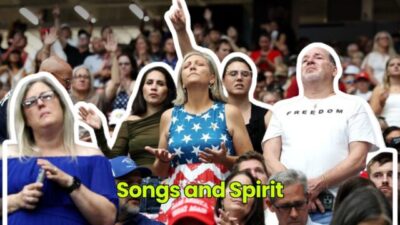
If there was a part of the Charlie Kirk funeral that caught everyone off guard, it was the music. You expect tears at a service like this. You might even expect flags and political speeches. But what people weren’t ready for was how deeply the memorial service would lean into faith and song. The performances weren’t just background noise — they were central to the whole emotional experience.
The standout moment? Lee Greenwood. Yes, that Lee Greenwood. When he walked out and sang “God Bless the USA,” the entire stadium stood up. People cried, held each other, and sang along with their hands over their hearts. Some waved mini flags. Others just closed their eyes and let the moment wash over them. It was moving, even for people who don’t typically go to church or listen to country music. It felt like more than a performance — it felt like collective healing.
But it wasn’t just Greenwood. A full gospel choir from a Phoenix-area megachurch brought the house down with “Amazing Grace” and “How Great Thou Art.” There were also acoustic performances by young artists from Turning Point USA who had worked closely with Kirk’s organization. These weren’t polished, celebrity-level acts. They were raw, personal, and honestly — beautiful. You could tell they weren’t just singing for Charlie. They were singing with him in mind.
Even for attendees who didn’t share Charlie’s religious convictions, the music brought people together. That’s the funny thing about songs — they bypass politics. They go straight to the heart. And during those few minutes of harmony, the divisions in the room seemed to blur. The music reminded everyone that behind the rhetoric, behind the headlines, this was still a funeral. And people were hurting. Deeply.
Media Coverage and the Frenzy That Followed
You knew it was coming — the media circus. Before the first speaker even approached the mic, reporters were already firing off hot takes. Cameras were stationed at every angle of the State Farm Stadium in Glendale, and headlines were being pre-written faster than Trump’s teleprompter lines. The New York Times, Fox News, CNN, and everyone in between showed up, eager to frame the event for their audiences. And yes, the narratives varied wildly.
Left-leaning outlets focused on the politicization of the service. Some criticized how much of the event felt like a rally rather than a solemn memorial. They highlighted Trump’s speech and questioned whether it crossed the line into campaign territory. Words like “theatrical,” “self-serving,” and “strategic” were tossed around freely. These critiques weren’t exactly surprising — Kirk’s death was always going to stir the pot. But they did highlight a deeper unease about the blending of mourning and messaging.
Conservative media, on the other hand, went all in. They framed the funeral as a patriotic tribute, an emotional outpouring of love for a man who “stood up when others stayed silent.” Fox News aired hours of coverage. Newsmax called it “a spiritual awakening.” Headlines included phrases like “Charlie Kirk’s Legacy Lives On” and “America Loved Charlie Kirk.” The emotional moments — especially from Erika Kirk — were played on repeat across every conservative platform.
All of this left everyday viewers wondering: were we all watching the same event? Depending on your media diet, the funeral looked either like a bold stand for freedom or a campaign rally disguised as grief. And that’s the reality of modern coverage. Facts are filtered. Emotions are framed. And moments of unity? Sliced into narratives that suit the headline. Still, the media frenzy only confirmed what we already knew — Charlie Kirk’s funeral wasn’t just personal. It was political.
READ ALSO: D4vd Tesla Case Breakthrough: Dead Body Identified
Social Media Explodes: Grief, Tributes, and Backlash
If the news media was buzzing, then social media was on full-blown fire. Within minutes of the first photo surfacing from the stadium, #CharlieKirk, #KirkForever, and #RIPCharlie were trending worldwide. TikToks were made. Instagram stories were flooded with black-and-white photos and tearful reflections. Twitter? That was a war zone. Comments flew in from every direction — some kind, some cruel, and many somewhere in between.
Entire airplanes full of passengers are singing “Amazing Grace” as they touch down in Phoenix for Charlie Kirk’s funeral!
How great is our God?!? pic.twitter.com/GY4CHm2kPc
— Mark Lynch (@MarkLynchSC) September 21, 2025
Supporters used social media to grieve publicly. They shared clips from Erika Kirk’s eulogy, quotes from Trump, and videos of the gospel choir singing their hearts out. Influencers from Turning Point USA posted behind-the-scenes moments and tributes, some heartfelt, others clearly curated. Charlie’s message — faith, freedom, and political activism — echoed through every hashtag. People described him as a fighter, a mentor, a voice for conservative youth. It wasn’t just a feed of memories. It was a digital shrine.
But let’s not pretend it was all love. The backlash came just as fast. Critics slammed the Charlie Kirk funeral services for feeling “too branded.” Memes emerged mocking the production scale of the event. Hashtags like #ForgetCharlieKirk and #JustATribute started trending alongside the positive ones. Some people accused his supporters of using the funeral to perpetuate division. Others questioned the sincerity of some public displays of grief. It got messy — fast.
Kind of more striking who didn’t speak at Charlie Kirk’s funeral—neither of his parents, no siblings, no old friends, just his wife, Carlson, and a whole lineup of Trump people he maybe knew getting in their agenda talking points. He really was worth more to MAGA dead than alive
— GL DiVittorio (@gldivittorio) September 22, 2025
That’s the nature of social media, though. It gives everyone a voice, but it also amplifies chaos. For every post that mourned Charlie’s death, there was one that debated whether his influence was harmful. The internet didn’t just watch the funeral — it became part of it. The conversation didn’t end when the service did. It exploded into timelines, comment sections, and DMs. And honestly? It might not stop for a long time.
Final Thoughts on the Charlie Kirk Funeral
So what do we make of all this? The Charlie Kirk funeral wasn’t just a memorial — it was a symbol. A symbol of how modern America mourns, how it gathers, how it disagrees. It was big, bold, emotional, and political. It brought together people from all over the country and shoved their emotions — and their beliefs — into the spotlight and forced everyone watching to ask: are we here to grieve or to galvanize? Maybe the answer is both.
One thing that stood out was the scale. State Farm Stadium in Glendale Arizona is no small venue, and yet it was packed. That tells you something about the reach and influence of Charlie Kirk, for better or worse. You don’t pull tens of thousands of people into a stadium unless you’ve made an impact. Whether you saw him as a bold voice or a divisive figure, you couldn’t deny that his platform was powerful — and that his death struck a nerve.
But scale doesn’t equal unity. While the event was filled with tributes and tears, it was also filled with tension. From Trump’s speech to the online backlash, it was clear that Kirk’s legacy is complicated. That’s not necessarily a bad thing. In fact, it’s probably honest. He wasn’t universally loved. But he was deeply loved by some, and fiercely opposed by others. And that’s the mark of someone who truly shook the table.
If nothing else, the funeral served as a moment of reflection. Not just on Kirk’s life, but on where the country is headed. It reminded people that politics isn’t just policy — it’s people. And when one of those people is lost to violence, we’re forced to reckon with the environment we’ve created. Whether you honor him or criticize him, the echo of Charlie’s message is still being felt.
Conclusion: A Legacy Cemented
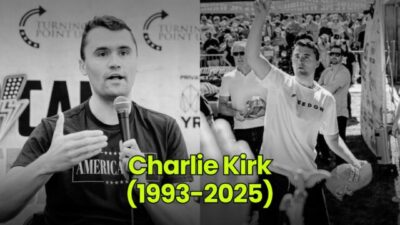
So here we are, at the end of one of the most talked-about funerals in recent American memory. The banners have been folded. The music has faded. The stadium is quiet again. But the conversation? It’s still raging. And that’s how you know the impact was real. Charlie Kirk’s memorial service didn’t tie things up neatly. It unraveled a lot of feelings, beliefs, and questions — and it left them all on the table.
Charlie Kirk was not a universally loved figure, and his ideas weren’t ones everyone agreed with. But no one can deny that he left a mark — on his followers, his critics, and the national conversation. In death, as in life, he sparked debate. He created emotion. He got people talking. And whether you mourned at the funeral or shook your head from home, you were probably thinking about it the next day. That says something.
His wife, Erika Kirk, showed a level of strength and sincerity that moved even those who weren’t fans of her husband. Her words made the day feel real — not just political. She reminded everyone that behind every movement is a person, and behind that person is a family. Her tribute was the most human part of a very public spectacle. And it deserves to be remembered.
In the end, Charlie’s legacy will be defined by more than just his politics. It’ll be defined by how he inspired people — whether that inspiration was to fight for his cause or to speak against it. Because real influence doesn’t ask for agreement. It demands attention. And based on everything we saw at the memorial for Charlie Kirk, he got exactly that. God bless, and here’s hoping we all learned something — even if it’s just how not to let politics drown out our shared humanity.
READ ALSO: Jimmy Kimmel Show Canceled After Comments On Charlie Kirk














Comments